Case Study 002
6 months.
6 inches off the waist.
176 LBS to 168 LBS
- Waist
- 39 IN to 33 IN
- Duration
- 6 MONTHS
- Location
- Canada
- Start
- 176 LBS
- Finish
- 168 LBS
- Waist
- 39 IN to 33 IN
- Duration
- 6 MONTHS
Body recomposition
A recomposition,
not just weight loss.
Authentic transformation evidence
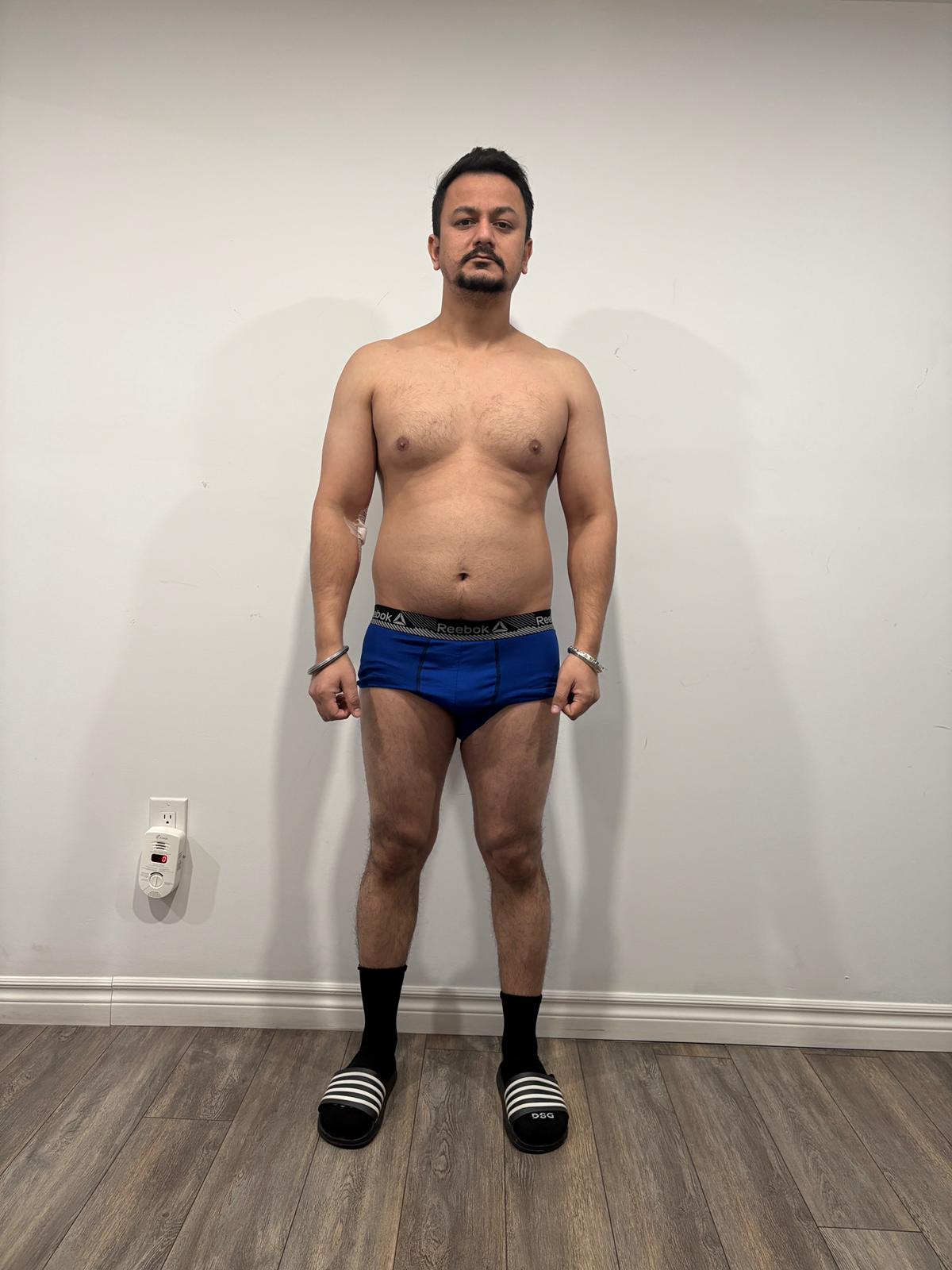
Month 0.
Month 6.
The photographs were taken in different environments and poses. Both are presented authentically without physique alteration or false visual symmetry.

The objective
Rebuild the system
behind the physique.
Manpreet came to Pack Leader Coaching after several years of on-and-off training without seeing the level of physique development his effort should have produced.
He had approximately three to four years of previous training experience, but much of that time had been spent following bro-style training, inconsistent nutrition strategies and random advice gathered from friends and online sources.
He had even worked with a previous coach, yet his physique, digestion and overall progress remained largely stagnant.
The objective was therefore not simply to make the scale move.
We needed to rebuild the system behind the physique.
The goal became a complete body recomposition: reduce abdominal and lower-back fat, improve muscular development, restore productive training progression and create a structure his body could continue responding to.
The challenge
High output.
Finite recovery.
Manpreet's starting point required more than simply reducing calories.
He works full-time and routinely accumulates approximately 15,000–17,000 steps per day, creating a naturally high daily energy expenditure before structured training and cardio are even considered.
At the beginning, digestion and recovery were also inconsistent.
Previous approaches had relied too heavily on doing more—more restriction, more training and more accumulated fatigue—without adequately managing the recovery required to adapt to that workload.
With a high-output lifestyle, simply forcing calories lower would eventually compromise training quality, recovery, energy and the ability to retain or build muscle.
The challenge was therefore to create enough stimulus and energy deficit to drive fat loss while preserving the resources required for performance, recovery and muscular development.
The goal was not to create more fatigue. The goal was to create a better adaptation.
The Pack Leader strategy
Three phases.
One evolving strategy.
Progression was earned through structure, measured response and fatigue management—not a single static plan.
Baseline & Response
We deliberately avoided rushing the transformation.
The initial phase focused on establishing the variables required for productive progress:
- Consistent structured nutrition
- Improved meal organization
- Digestion management
- Sleep and recovery
- Appropriate training volume
- Consistent resistance training
- Gradual introduction of cardiovascular work
- Daily activity monitoring
- Establishing reliable weekly check-in data
As consistency improved, bloating reduced and his physique began responding more predictably. The purpose of this phase was not to produce the fastest possible scale drop. It was to create a body and routine capable of responding to the phases that followed.
Recomposition
Once the foundation was established, the objective shifted toward controlled fat loss while continuing to improve muscularity and training performance.
Calories were adjusted progressively rather than crashed immediately.
Protein remained consistently high.
Carbohydrate intake was organized strategically around training demands.
Training progressed from a simpler recovery-conscious structure into increasingly individualized hypertrophy programming with progressive overload.
Cardiovascular work and daily activity were adjusted according to response rather than increased arbitrarily.
Throughout this phase, scale weight became only one data point.
Waist measurements, visual changes, training performance, recovery, digestion and adherence provided a much more complete picture of what was actually happening.
Advanced Cutting & Fatigue Management
As the transformation progressed and adaptation occurred, the strategy became more aggressive—but never blindly aggressive.
Calories and carbohydrates were progressively adjusted when required while protein remained high and resistance training continued to provide the primary muscular retention and development stimulus.
Cardiovascular demands increased progressively.
However, Manpreet's already-high daily activity meant recovery had to be monitored carefully.
When energy, performance and recovery indicated accumulating fatigue, we did not automatically respond by pushing harder.
Strategically timed higher-calorie/refeed periods were used when appropriate to support training output, adherence and recovery.
Planned deloads reduced accumulated training fatigue when required.
The objective was to create repeated productive training and nutrition phases rather than allowing prolonged restriction to drive performance into the ground.
Progress required pressure.
Sustainable progress required recovery.
Training evolution
Progressive.
Recoverable.
Individual.
Manpreet's training evolved alongside his physique.
We moved away from generalized bro-style training and toward structured hypertrophy programming built around progression, recoverability and his individual development priorities.
Programming evolved from simpler foundational work into structured upper/lower and push-pull-legs elements before becoming increasingly individualized.
Specific emphasis was placed on developing:
- Upper chest
- Lat width
- Back thickness
- Delts
- Hamstrings
At the same time, unnecessary volume and excessive lower-back fatigue were controlled.
The objective was not to perform the greatest possible number of exercises.
The objective was to generate enough high-quality stimulus to progress while remaining recoverable.
Training performance continued improving even as the physique became leaner.
The outcome
The scale moved modestly.
The composition did not.
- Starting bodyweight
- 176 LBS
- Final bodyweight
- 168 LBS
- Scale change
- 8 LBS
- Starting waist
- 39 IN
- Final waist
- 33 IN
- Waist change
- 6 IN
- Duration
- 6 MONTHS
If this transformation were judged only by scale weight, the result could easily be underestimated.
Eight pounds separated Manpreet's starting and finishing bodyweights.
His waist, however, decreased by six inches.
At the same time, his upper body became visibly more developed, his arms and delts appeared fuller, his shoulder-to-waist ratio improved and his overall physique became substantially more athletic.
Abdominal and lower-back fat decreased considerably while muscularity was retained and visually improved.
Training performance continued progressing.
The result was not simply a smaller version of the starting physique.
It was a different body composition.
The scale moved 8 lbs.
The physique changed completely.
Why this case matters
Bodyweight is one measurement.
Not the entire outcome.
Manpreet's transformation demonstrates why bodyweight alone cannot define progress.
Successful recomposition can involve simultaneously reducing fat mass, retaining or increasing lean tissue, improving training performance and changing the proportions of the physique.
When those variables move together, dramatic visual change can occur without dramatic scale change.
This is why Pack Leader Coaching evaluates more than one number.
Bodyweight trends matter.
But so do waist measurements, progress photography, training performance, recovery, digestion, activity, adherence and the context surrounding those variables.
We don't coach a scale. We coach the physique and the person behind it.
Execution
Six months.
One standard.
A six-month recomposition requires more than a short burst of motivation.
Manpreet continued executing through changing calorie targets, increasing activity demands, progressive training, planned refeeds, deloads and periods where recovery had to take priority over simply doing more.
His consistency allowed each phase to generate meaningful data.
That data allowed the strategy to evolve.
And that evolving strategy allowed the physique to continue progressing even when scale weight was no longer the most important measure of success.
The plan evolved. The standard remained.
Client perspective
I had been training for years before working with Pack Leader, but I was mostly following random advice from friends, things I saw online and whatever seemed to make sense at the time. I had even worked with another coach before, but my physique wasn't really changing and I never felt like there was a complete system behind what I was doing.
The biggest difference with Pack Leader was that everything started being managed together. My training, nutrition, cardio, digestion, recovery and weekly progress were all looked at as part of the same process instead of separate things.
Because I work full-time and usually get 15,000–17,000 steps every day, there were times during the cut when simply eating less and doing more was starting to affect my energy and recovery. Instead of just pushing harder, we adjusted the plan, used refeeds when needed, managed fatigue and deloaded training at the right times. That allowed me to keep progressing and getting stronger while becoming leaner.
What surprised me the most was the difference between the scale and the mirror. I started at 176 lbs and finished at 168 lbs, so the scale changed by eight pounds. But my waist went from 39 inches to 33 inches and my physique looked completely different.
For the first time I understood what proper structure and coaching actually meant. I wasn't just trying to lose weight anymore—I was building a better physique while learning how my body responded.
The results changed the way I look at training and nutrition completely.
Coached by Pack Leader
Discipline.
Execution.
Results.
Transformation is not always measured by how much weight disappears.
Sometimes the strongest evidence is what changes while bodyweight barely moves.
Apply for coachingIndividual results vary. Outcomes depend on starting condition, adherence, lifestyle and other individual factors.